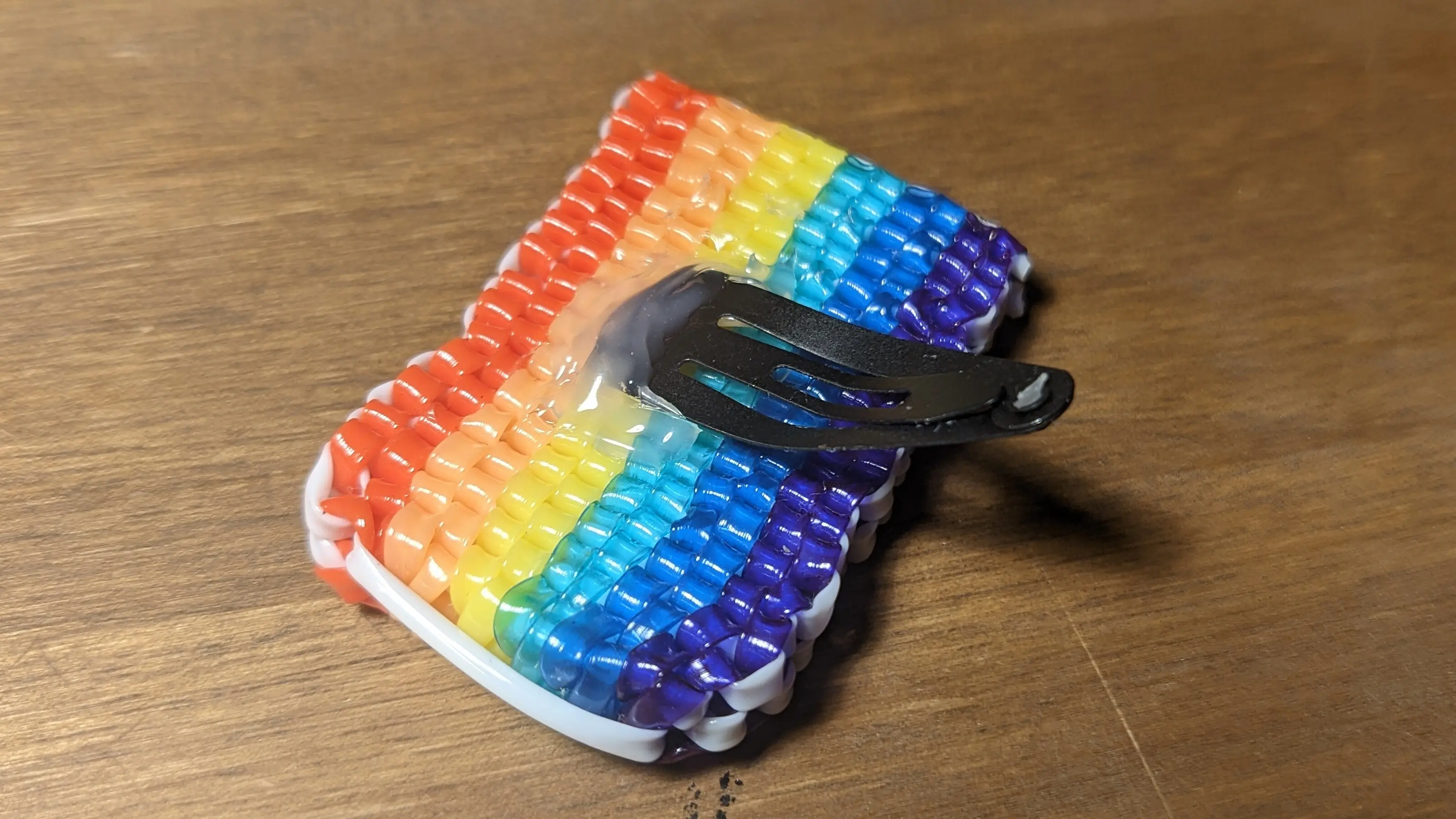
Scoubidou Pride Flags
September 8, 2025A couple of weeks ago I went to a local CSD pride demonstration, and because I still don’t own a pride flag (shame on me), I decided to make a small rainbow pride hairpin instead.
Materials
This process can be used for all sorts of combinations of striped flags
or even single-coloured flags.
But if you want to replicate the exact flag I made, you’ll need Scoubidou strands in the following colors:
- 1x Red
- 1x Orange
- 1x Yellow
- 1x Green
- 1x Blue
- 1x Purple
- 1-2x White (for the off-axis parts)
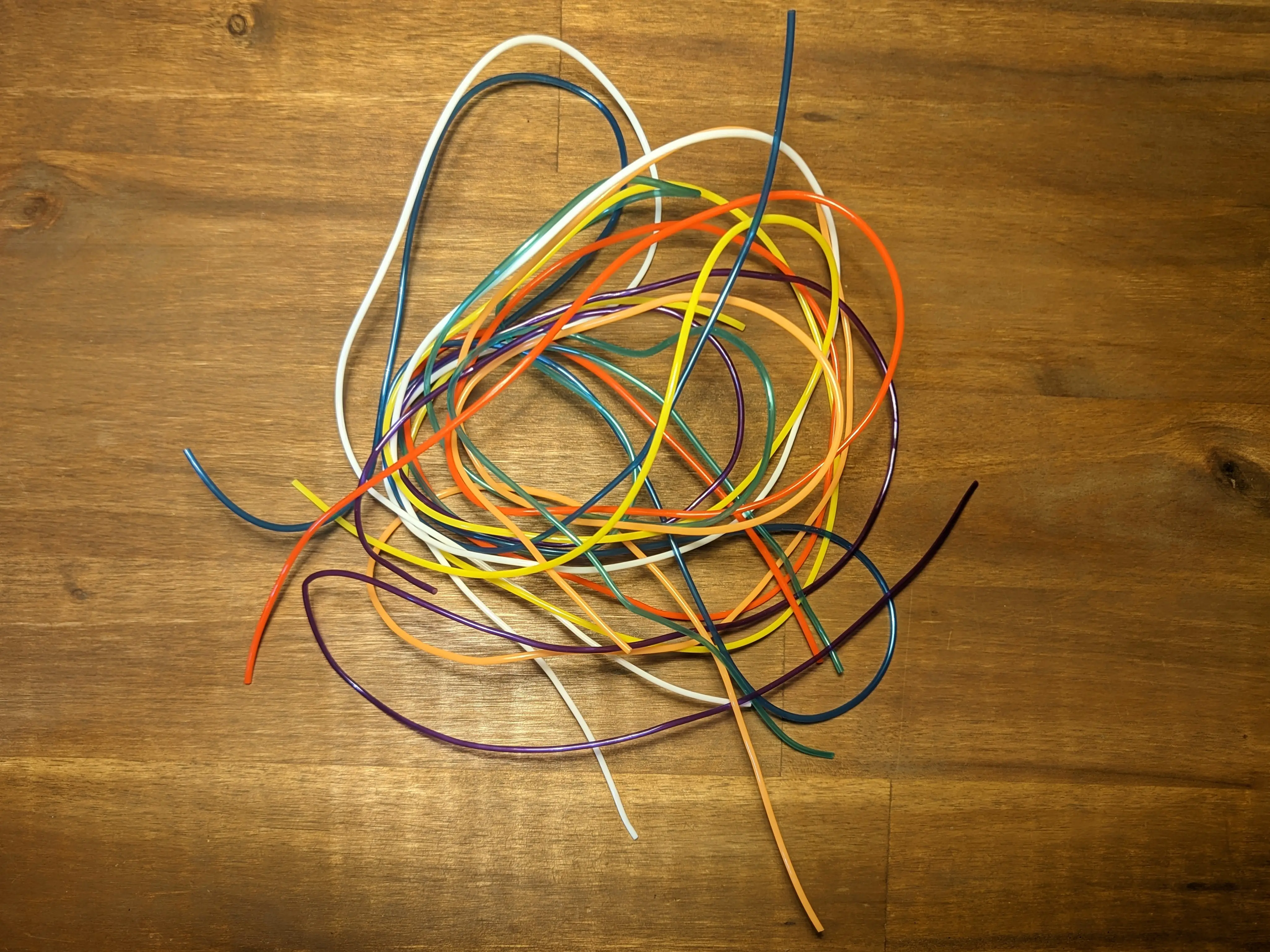
Additionally, you will need a lit candle or lighter to apply heat when sealing the strands together.
And a pair of scissors to cut off excess materials.
Prelude
If you have never done Scoubidou, I’d honestly recommend you learn a basic box stitch with two strands first.
But if you are familiar with how it works, you’ll find the process very similar;
the only difference is that we are using more strands, and everything becomes a little harder to manage.
In the following pictures, I’ll be sticking down the strands on my table,
as it helps to keep them aligned, especially at the start.
It also makes it a lot easier to photograph them, without everything coming apart.
I find that even when I’m not trying to photograph them
having something to hold them in place for the first couple of rounds makes it easier
and a lot less chaotic.
However, I think it is faster to do the rest while holding them with your hands, as you are more flexible that way.
Starting the Knot
Start by folding every strand in half and pressing it around the center mark
so that it forms a visible crease, which you can use as a reference.
Then I place the first white strand horizontally and align the other six coloured strands around it.
The red, orange and yellow strands are placed left of the white’s center mark, with their center mark on the white strand.
And the green, blue and purple strands are placed on the right of the white’s center mark,
also centered.
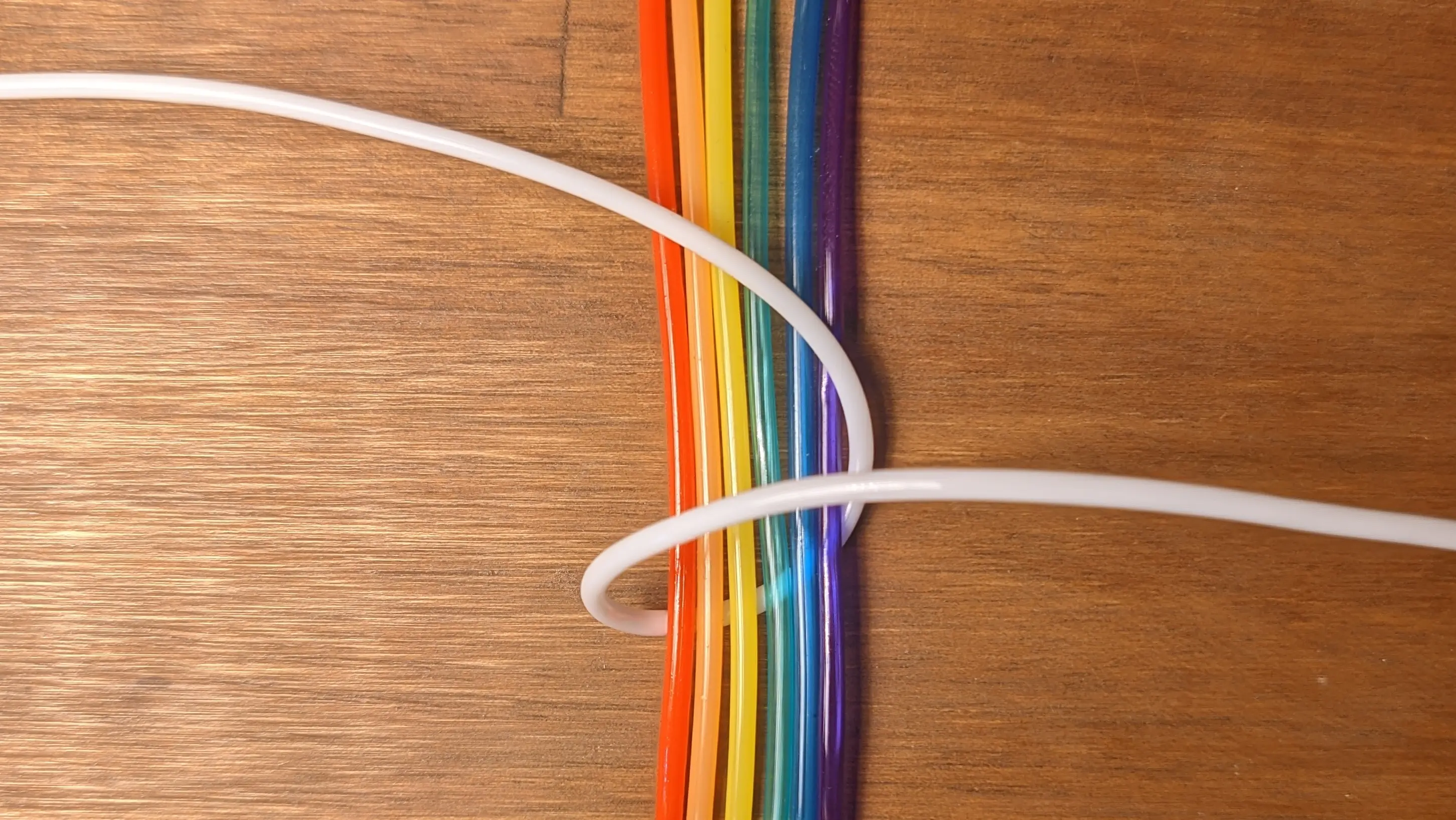
Now we’ll do the first knot by flipping over both white strands to the other side,
with the left half forming the bottom row and the right halft the top row.
The coloured strands are now moved over and under the horizontal strands.
In doing so, you want the bottom halves of the coloured strands to go over the bottom white strand
and under the top white strands.
You should also make sure that the bottom halves stay left of the corresponding top halves.
In contrast, the top halves will go over the top white strand, and under the bottom white strand.
Once all the strands are in place, you have to pull them tight,
and you should end up with something that looks like this:
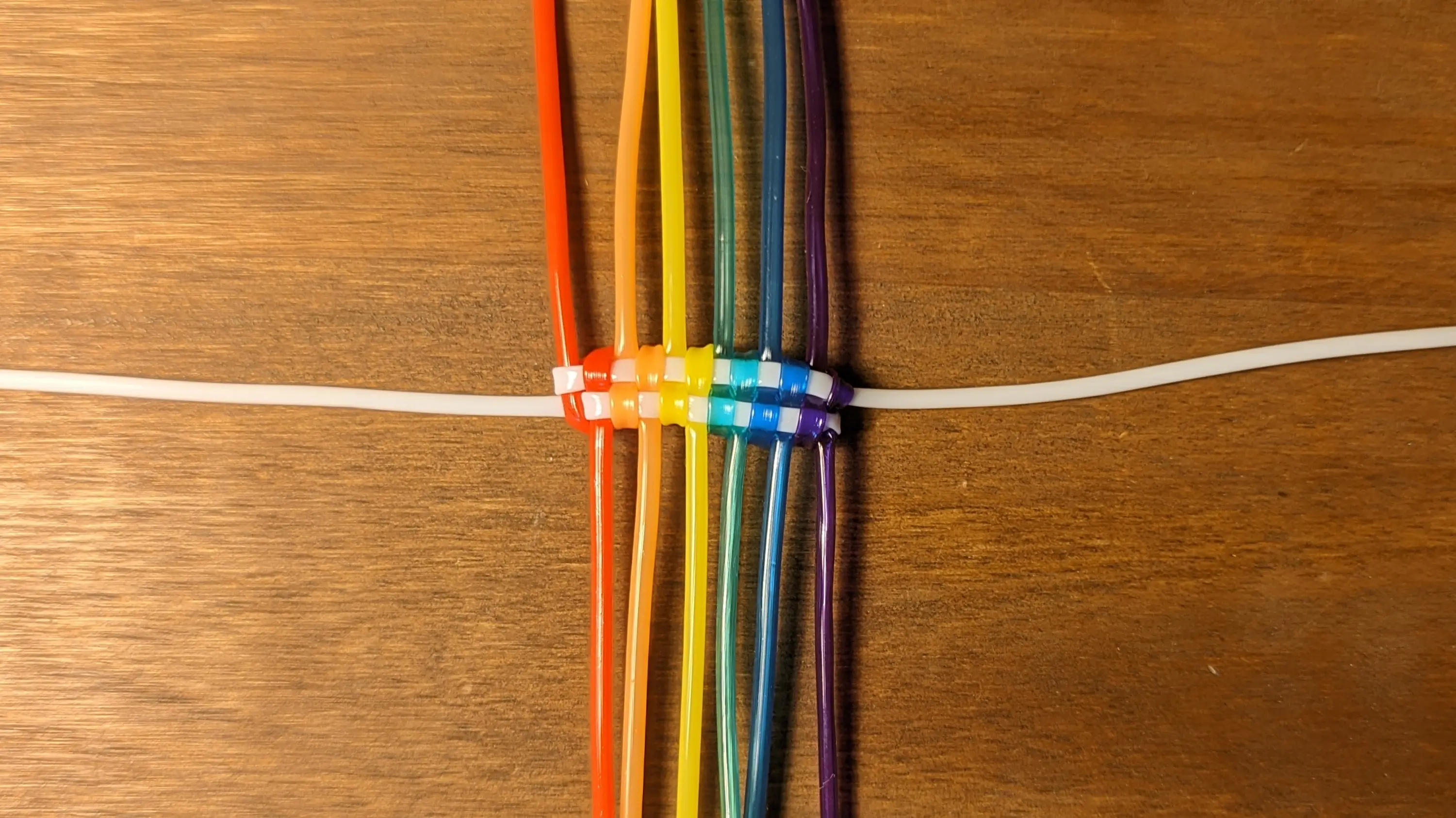
As we are only doing a simple flat flag,
you’ll essentially keep repeating this until you run out of strands.
Fold over the white strands, and move the coloured strands over the white strand closest to them
and under the white strand furthest away from them.
This is the perfect task to just sit comfortably, listen to an audiobook, and continue making knots.
Alternative Process
I personally find flipping both of the white strands over at the same time a little taxing in the long run, as I frequently lose track or get distracted.
For me, the fastest way to tie the knot is to flip over the white upper strand and form the loops over it with the top section of the coloured strands.
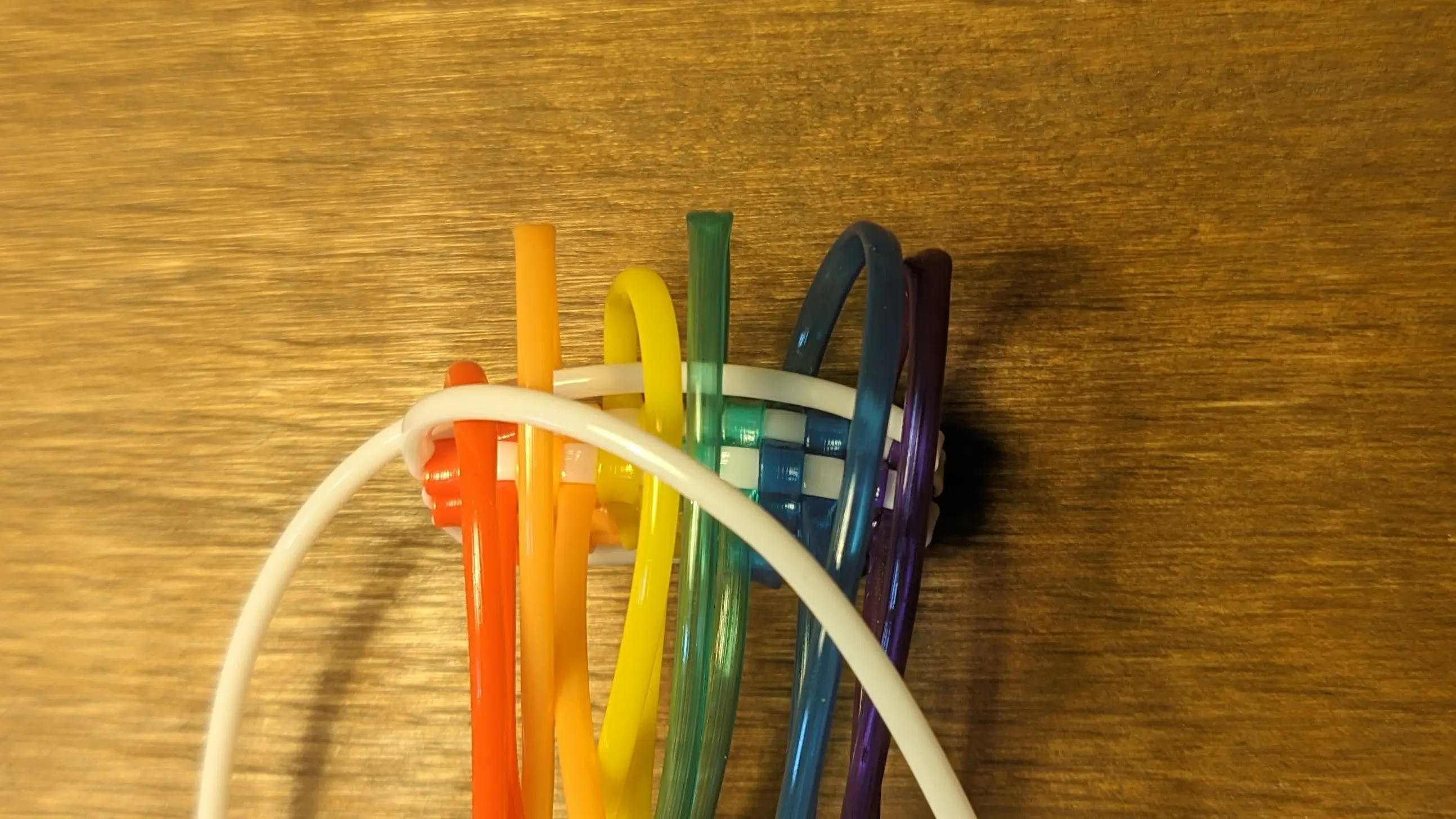
Afterwards, I move the lower white strand across, and loop the bottom halves of the coloured strands back up, making sure to keep them in the same column they were in before.
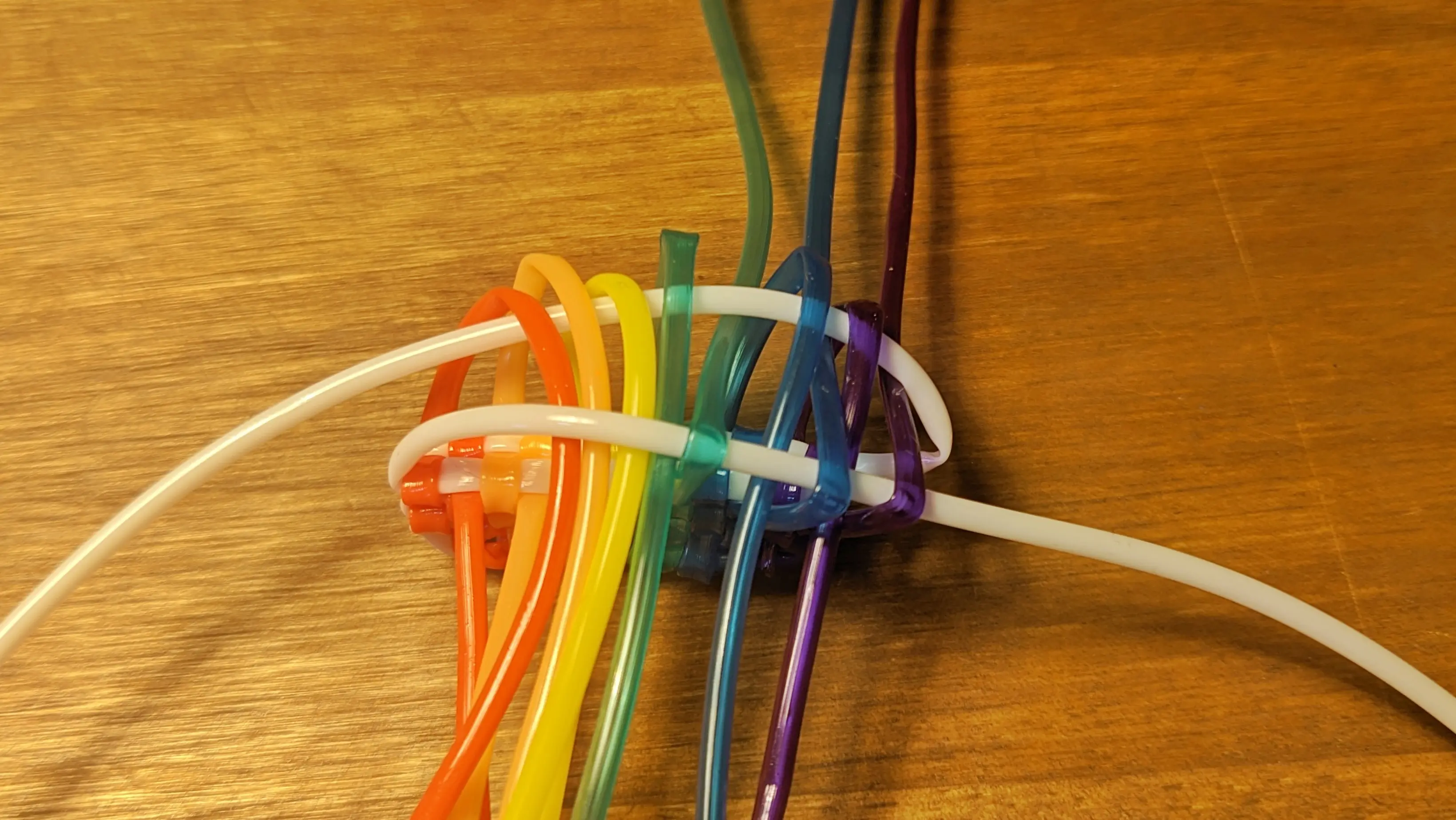
Lastly, I simply pull them tight and repeat the process.
Running out
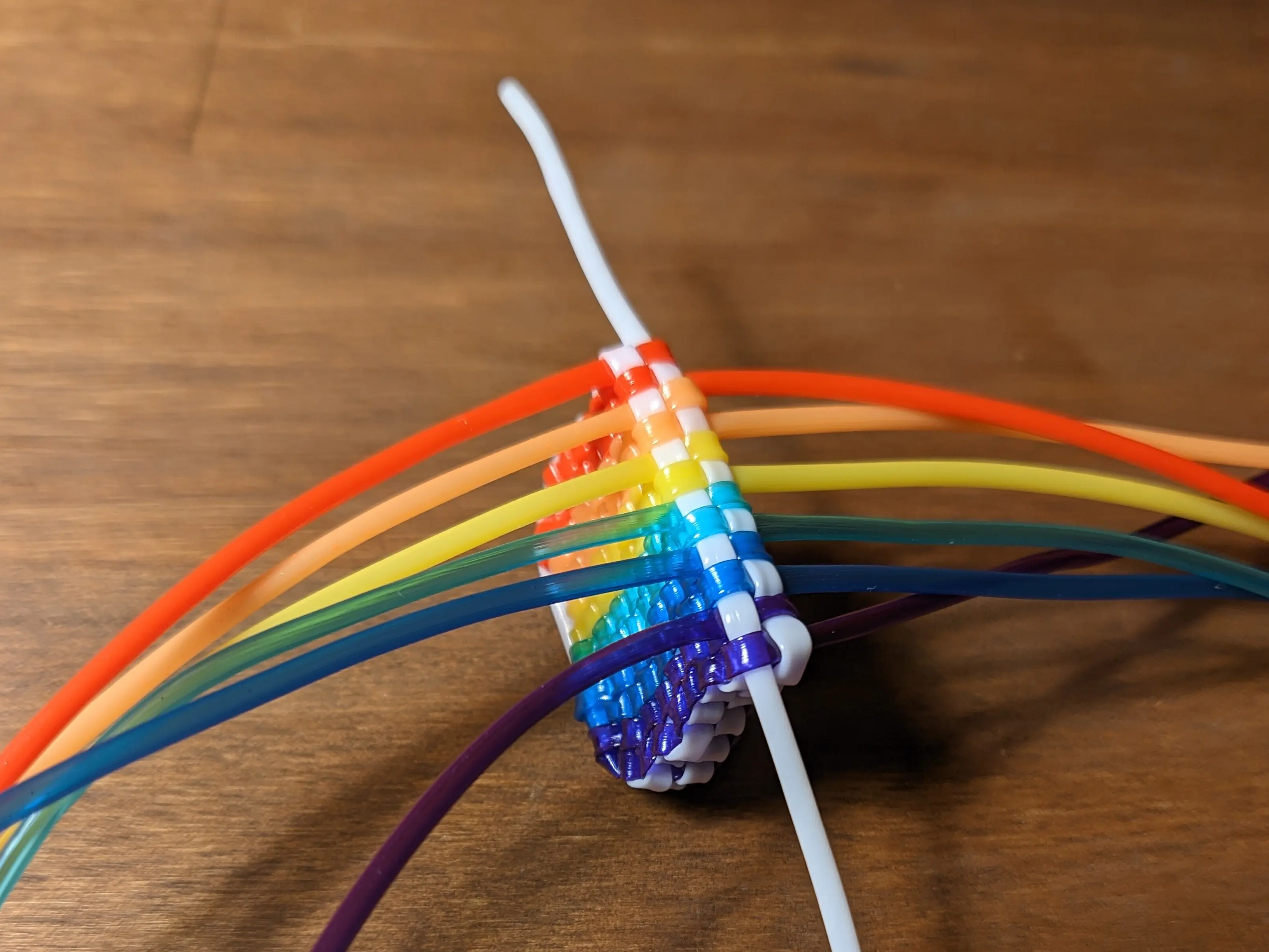
At some point I noticed that my white strands would not last for another round.
This is where the second white strand comes in.
You want to cut it in half and then cut the end on either side at a 45° angle.
The leftover white strands on the flag should also be cut at a 45° angle.
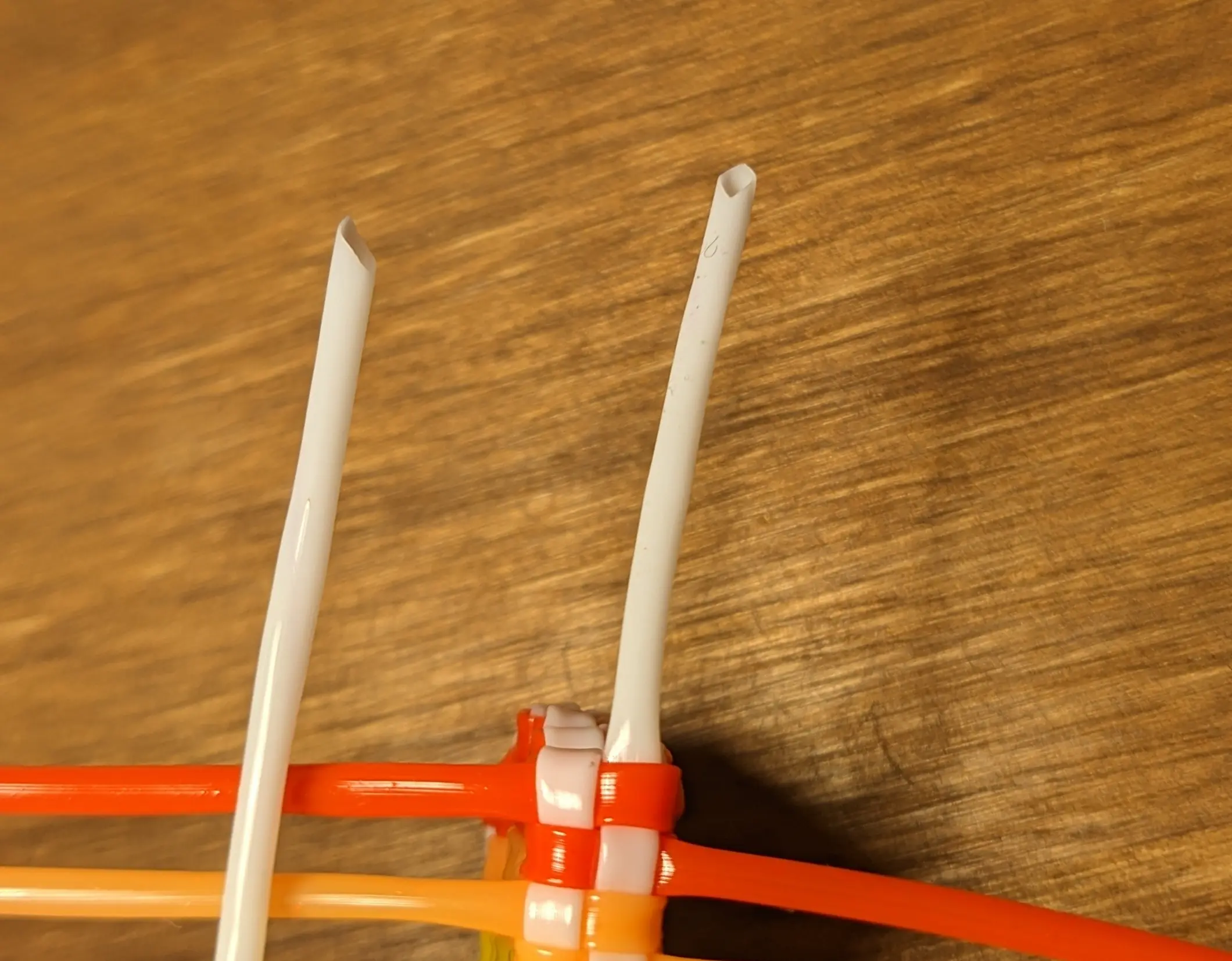
The angle makes it easier to push the strands into one another, one on either side.
With the strands connected, you can use the lighter to fuse (melt) them together.
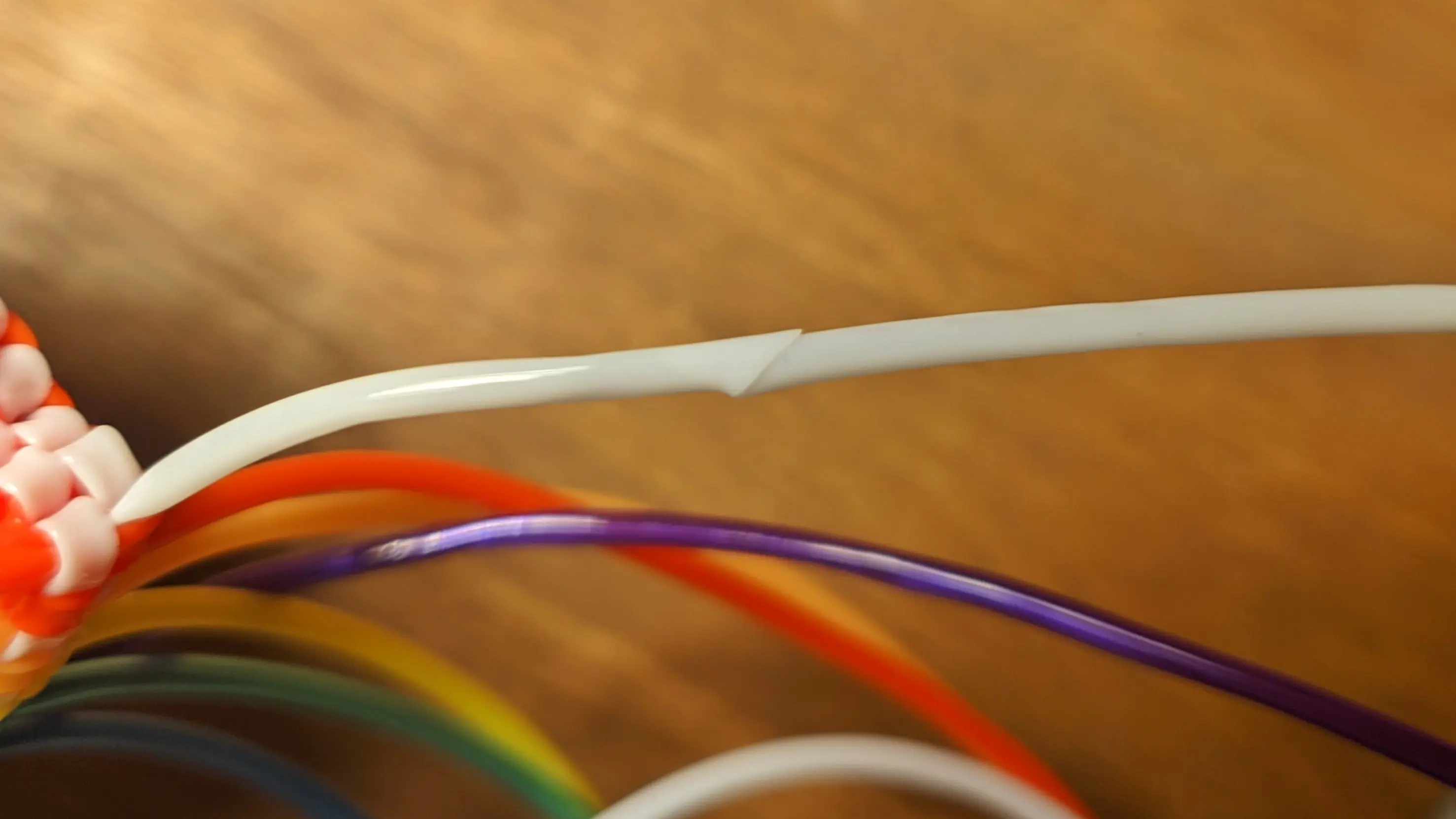
Afterwards, you can continue on as normal.
Just make sure not to pull too hard on the transition section, as it might break it apart.
Ideally, you should also make sure that the transition happens in the middle of the columns,
as that means that it won’t be as visible from the outside.
Finishing up
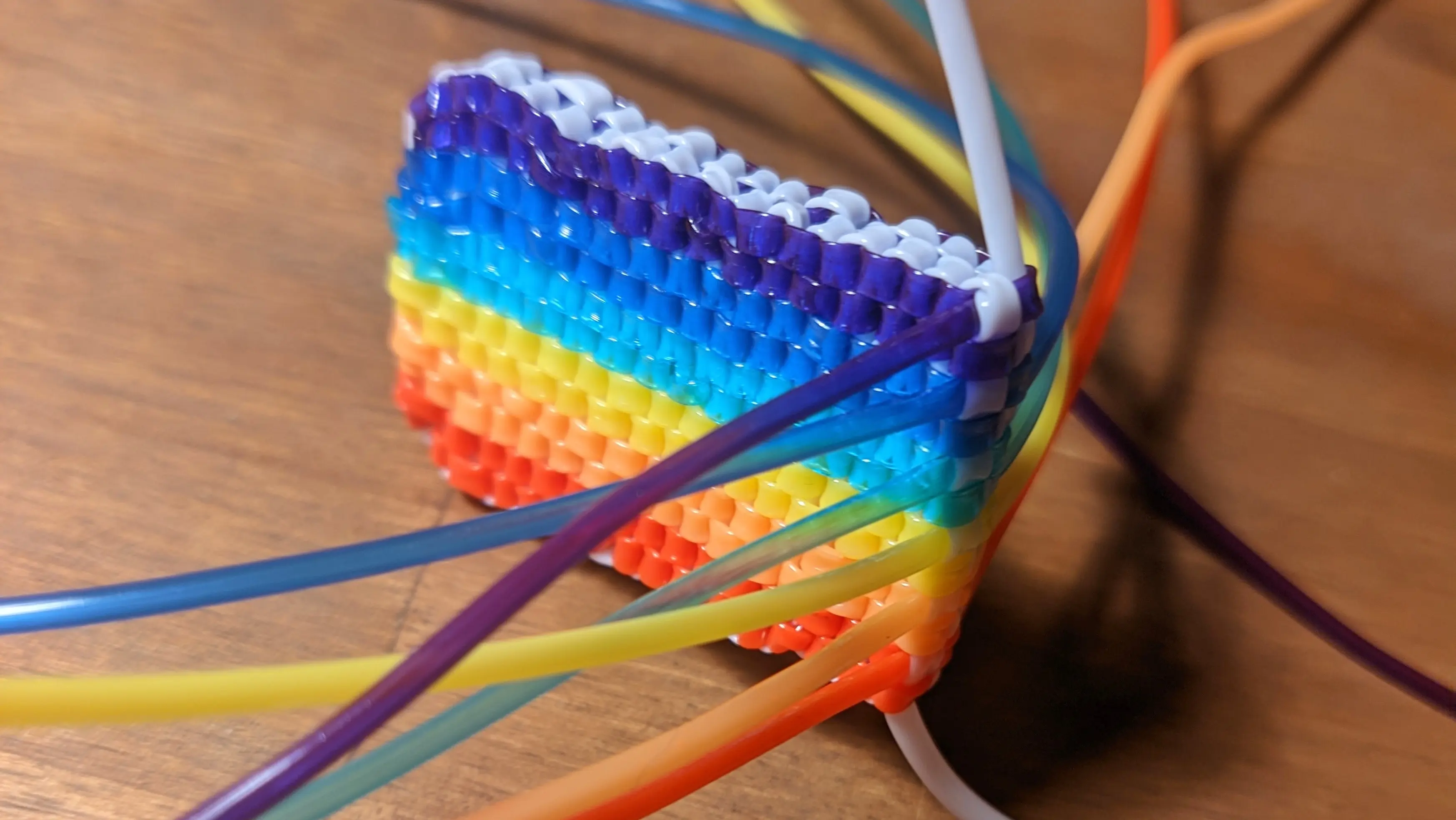
Once you reach the point where you are happy with the shape of your flag, you can stop adding more knots (obviously).
To make sure your knots won’t come apart, we’ll melt them together.
You can use the lighter to carefully heat up the end and press the hot end onto a cold surface,
like a glass plate, to fuse together all the ends of the last layer.
It might take you a couple of attempts, but once they are stuck,
you can use a pair of scissors to cut off the excess strands close to the body.
Leaving you with your finished flag.
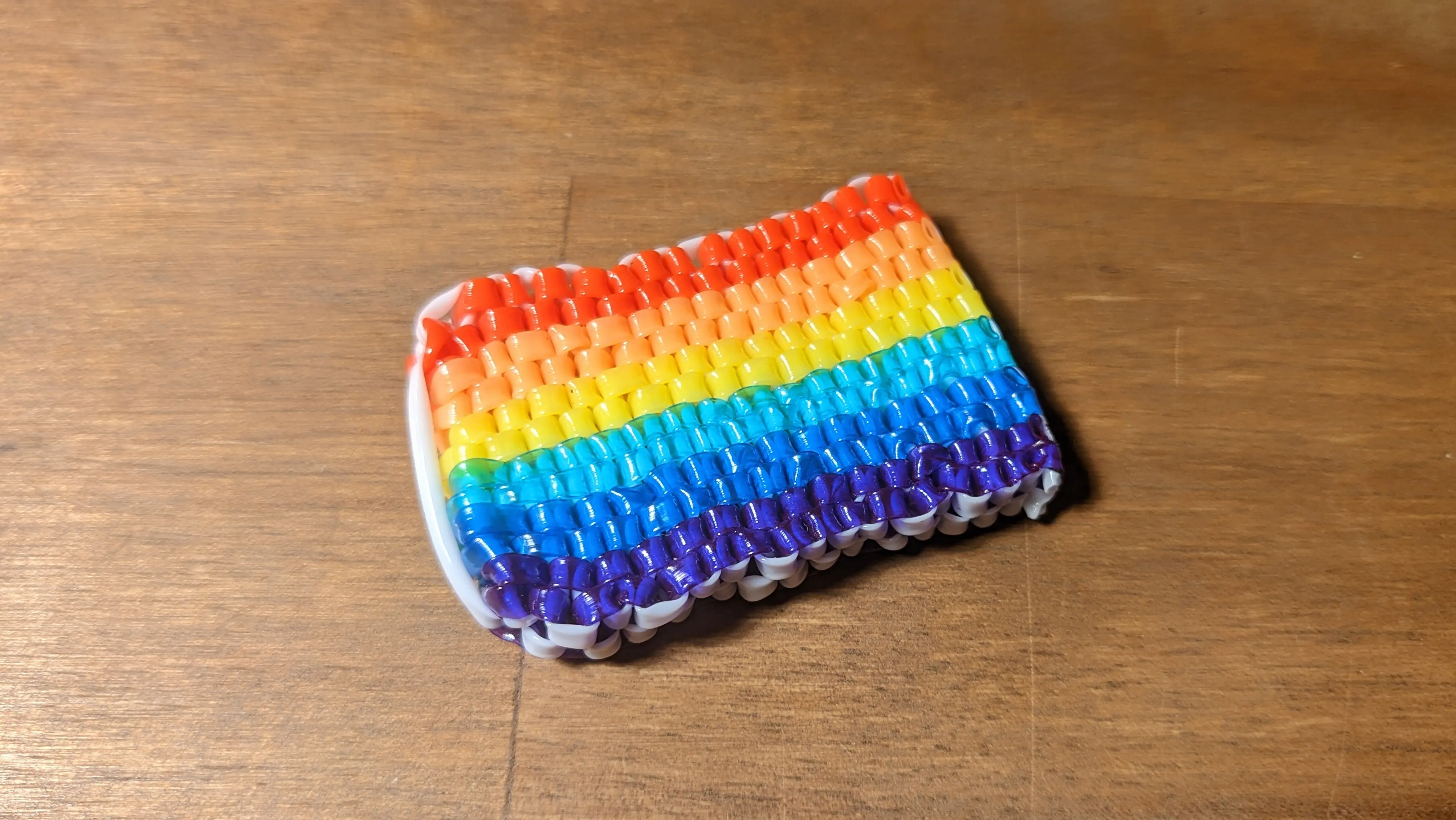
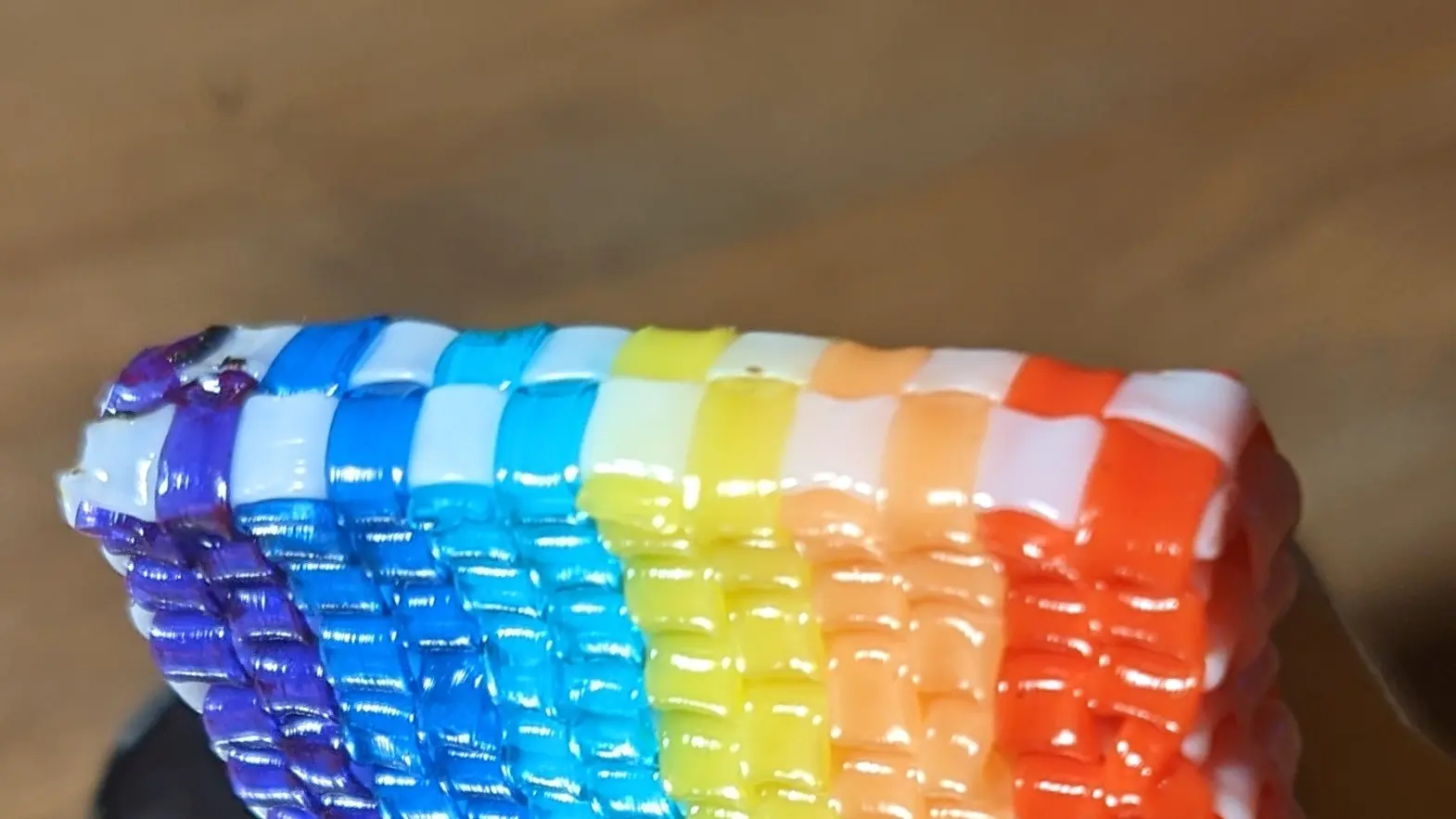
As you can probably guess, you can use the same technique to do different amounts of coloured strands,
i.e., four or five colors.
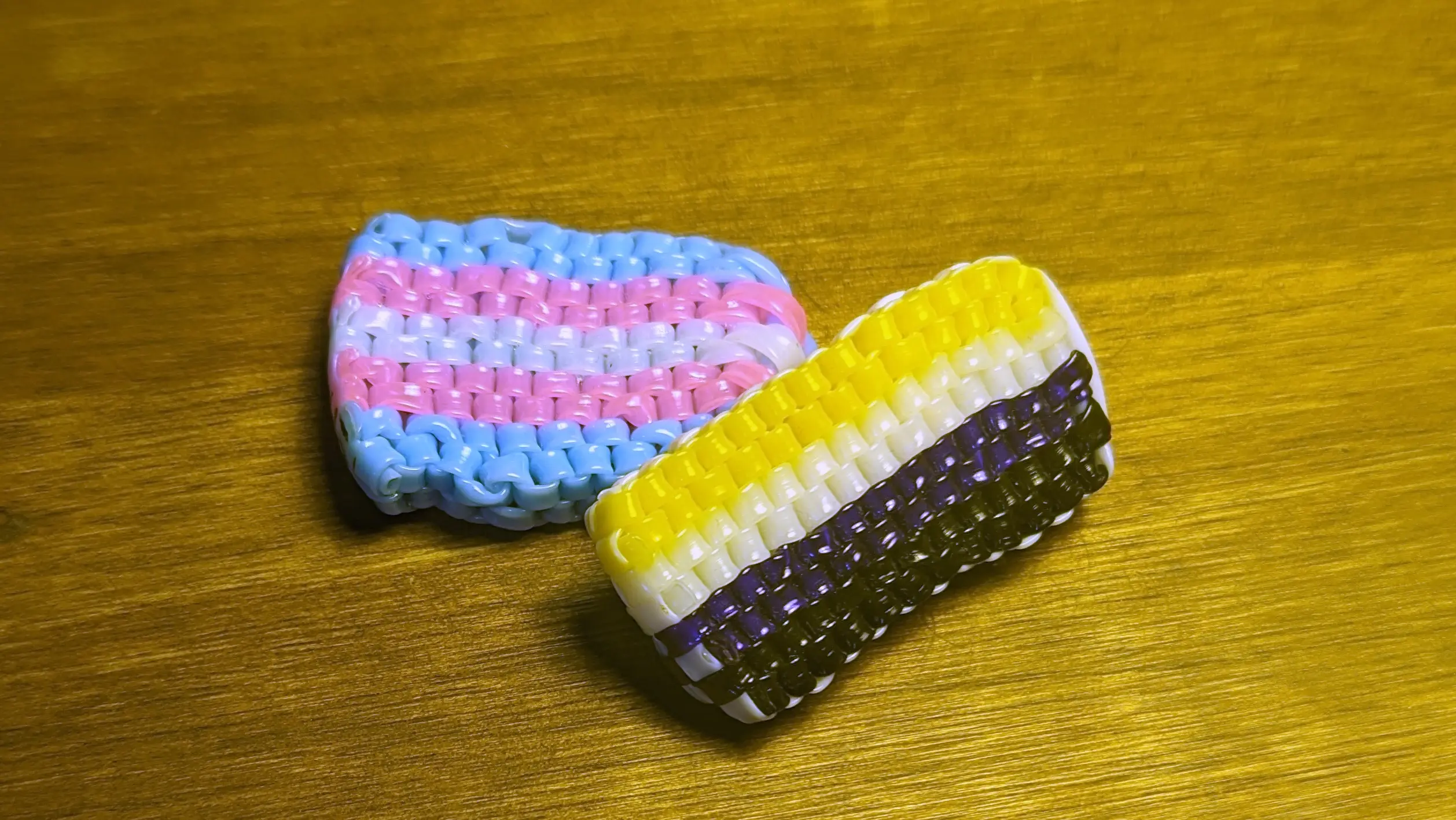
This is exactly what I did last year, when I made trans and non-binary flags.
Both of them used fewer strands though.
I used 2 blue, 2 pink, and 1 white strand for the flag stripes and a third blue strand for the off-axis when I made the trans flag.
And yellow, white, purple, and black for the stripes of the non-binary flag, with a second white strand for the off-axis.
Adding a hair clip
Because I wanted the flag to attach to my hair, I took a hot glue gun and applied some hot glue to the wider end of the hair clip.
Then I just pressed it against the back of the flag to stick it in place.
Luckily the textured surface of the knots makes it fairly easy for the hot glue to stick in place.
And because the strands are not actually sticky themselves, you can remove the hot glue by slightly stretching the flag and pulling on the glue.