Visualizing Identity
September 1, 2024I recently stumbled across
a post on Mastodon
that referenced a post by @OMGImAutisticAF:
“Why do you need a label?” Bc there is comfort in knowing you are a normal zebra, not a strange horse. Bc you can’t find community w other zebras if you don’t know you belong. And bc it is impossible for a zebra to be happy or healthy spending its life feeling like a failed horse
And I really quite like it,
as it is a perfect example of why finding labels that suit you,
can be really useful.
That is not to say that you have to put a label on everything -
maybe you feel better without one.
Or maybe you don’t want to put yourself in a specific box.
Imagine if there was a way to visually display, where you are on a spectrum.
Backstory
I initially called this post The Gender Triangle,
because for me, it is a triangle,
however whilst writing this post, I noticed,
that I wanted to focus on all the other shapes as well.
Additionally, this model is not restricted to gender,
which is why I renamed the post to Visualizing Identity.
Furthermore, I stumbled across the Trinary Genders
lgbtqia wiki entry, and I think I agree,
that fixing the number to three would be the wrong thing to do.
GLSEN Gender Triangle Education Guide
Before we dive into the topic of this post, let me quickly draw your attention to the Gender Triangle Education Guide, developed by GLSEN and interACT. I found this model while doing research for this and a couple of other posts, and I think it is interesting, how they use the placement of the components to symbolize how the outside is independent of the inside.
[It is] an educational tool to highlight the main components that revolve around gender identity - our bodies, how we use our bodies to express ourselves, and how the world around us reads our bodies based on the cultural and social codes of our time and place.

Instead of reiterating everything detailed in their info material, I’d recommend you go and read it yourself.
Visualization
Quick disclaimer:
The following model is based on how I perceive my own gender identity,
and how I think it could be used to reflect other things as well.
You don’t have to pick an identity to be valid 🏳️🌈.
Also, the next sections will involve a couple of images,
I’ll try my best to add proper alt text to them 💕.
As I said above, this model originated with me trying to display my gender perception. It can be seen as a combination and extension of Ternary plots, Radar charts and Plan position indicators.
The resulting chart consists of a number of points. The points are connected to one another and assigned a category (We’ll take a look at an exception later on). Whenever you want to add a new category, you add another point. Assuming that you want all the categories to have the same distance from one another, this means extending the dimension. Leading us to the first shortcoming of this visualization: Dimensions.
You see, we have yet to figure out how to imagine four dimensional objects, and here I am trying to draw a three-dimensional pyramid in 2D. Which is why, the following image will only go up to three categories, instead of four.
Drawing the chart
Let’s start with the basics, and work our way up. Remember, for now, we are only looking at ways to draw the chart.
The most basic shape is a single point,
or one category, as I like to call it.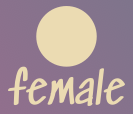
To add another category,
simply add a second point, and connect the two,
like a number line.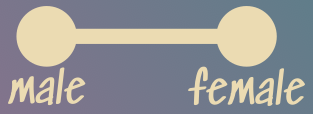
To be able to represent my gender identity,
I had to add yet another category.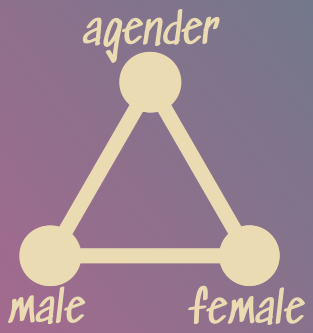
In theory, you could continue on like this,
with the next point creating a three-dimensional pyramid.
However, after that, it becomes quite hard for humans to imagine.
This is where this model fails, and you would be better off using
a radar chart.
You’ve got a point
Now that we have covered the basic chart shape, how about we add some data to it.
This is where Degrees of freedom come in, they basically specify in how many dimensions you are allowed to specify the values.
If you only have one category, it means that you have zero degrees of freedom,
you have to select the single category.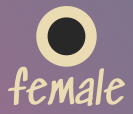
By adding one category, you gain a degree of freedom,
now allowing you to select a point on the line spanning
from one point to the next.
Because you can select any point, the data displayed is not necessarily binary.
It cannot be used to symbolize a third category,
but it can be used to symbolize feeling in between.
For example, feeling like a man and a woman at the same time
(Note: this is not the same as being agender nor non-binary,
although some people might feel like this).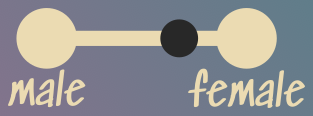
Similarly, you can pick any point inside the triangle I showed above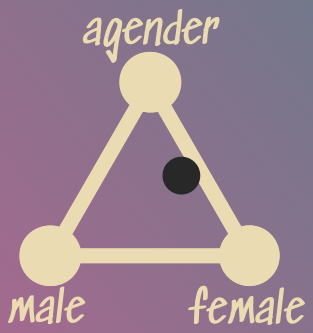
More than points
The coolest thing about having one or more degrees of freedom, is that you do not have to draw one single point.
Instead, you could draw multiple points, to show that your gender identity or sexual attraction fluctuates between these points. Similarly, you could also draw lines (or areas/objects, depending on the degrees of freedom) to show how they change over time.
Or you could also use it to show groups of people you are attracted to.
For example, depending on their definition, a bisexual person,
might highlight everything, when using three categories: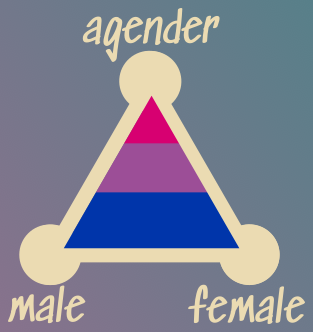
(Again: You don’t have to feel like this to be valid, I am not bisexual, but I know a couple of bisexual people)
The possibilities are nearly endless. If you haven’t found a box yet, maybe more degrees of freedom will help. And if not, no worries - you don’t need labels. You are valid
My gender triangle
Hi 👋, if you don’t know already, I identify as trans/non-binary.
The reason I decided to use three categories to represent my gender identity is that I feel like I’m partially genderflux and genderfluid. Fluidflux if you want.
Most of the time, I feel like a genderless blob,
but often it leans into female territory
and sometimes slightly masculine one.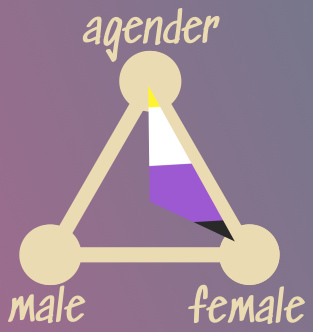
Note: this drawing is an approximation.
I also normally don’t talk or think about the specifics of my identity,
I just say I'm non-binary 🌸 and that is it.
I like labels, but I prefer, ✨ just being me, in that particular moment ✨.
Take care 😘